Dogs on trains: rules, tickets and travel tips
Travelling with a dog by train is possible in most European countries, but rules, fares and conditions vary by operator: a small dog in a carrier with a discounted ticket, a large dog muzzled and on a lead, or refusal on certain trains such as the Eurostar. Always check your company's conditions before booking.
Last updated 15 septembre 2026
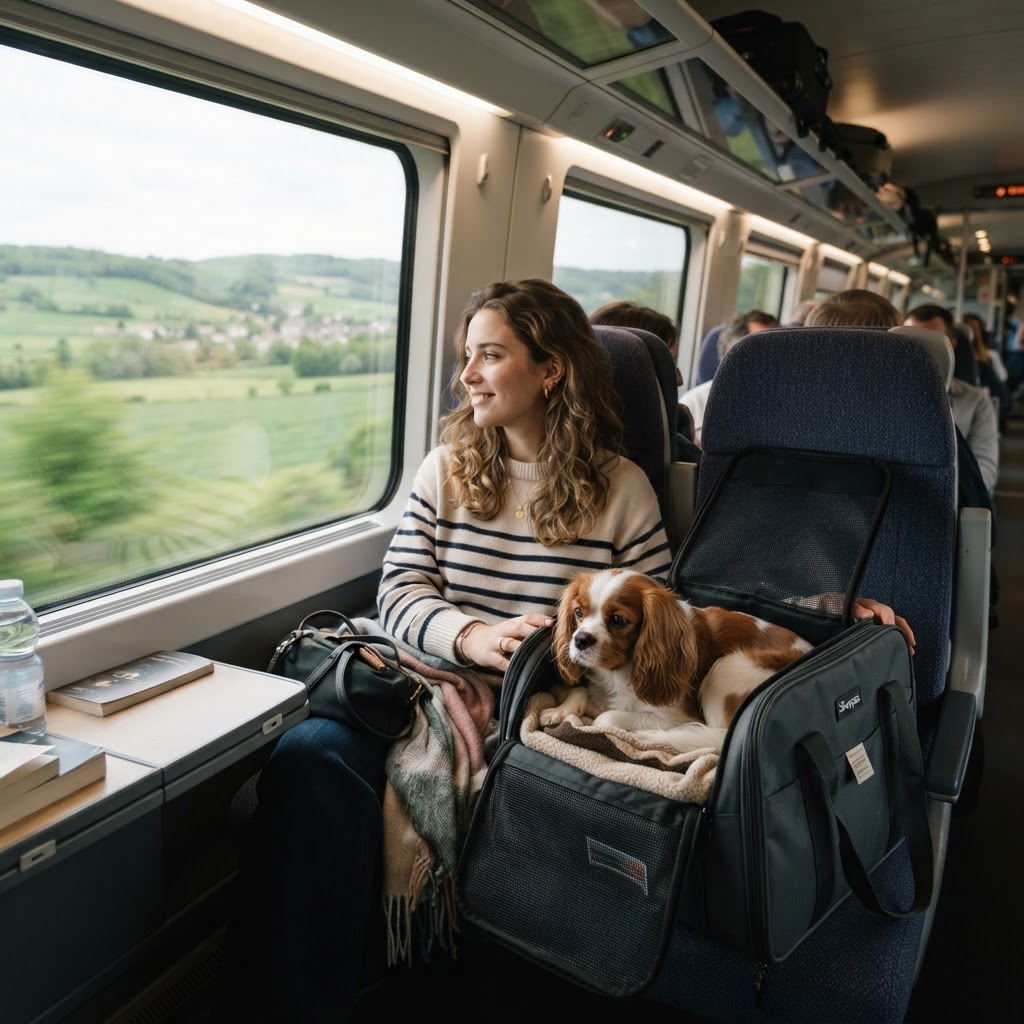
Dog-on-train rules by operator
Travelling with a dog by train is possible in most European countries, but there is no single rule: each operator sets its own access conditions, fares and equipment requirements. Here are the main trends:
- •SNCF (France): small dog in a carrier with a reduced flat-fare ticket; large dog muzzled and on a lead with a discounted ticket — check the official website before buying
- •Deutsche Bahn (Germany): dog with a discounted ticket or flat fare depending on its size, carrier required for small dogs
- •Eurostar (France – UK): only assistance dogs are accepted
- •Trenitalia, Renfe, ÖBB and other operators: conditions specific to each company, varying by country and type of train
The rules, fares and conditions for taking a dog depend entirely on the operator and can change: always check your company's official “travelling with a pet” page before booking your ticket.
Small dog: the carrier, a general requirement
For most operators, a small dog travels in a carrier or transport bag (with size and weight limits specific to each company), placed at your feet or on your lap. The dog generally has to stay in its carrier for the whole journey. Choose a carrier in which it can stand up and turn around comfortably, and get it used to staying inside several weeks before the trip.
Large dog on the train: lead and muzzle
Medium and large dogs are often accepted outside a carrier, provided they are kept on a lead and wear a muzzle, with a ticket purchased for the animal. The dog then travels on the floor, next to your seat or in the luggage area. Travel at off-peak times for more space, and get your dog used to wearing the muzzle at home before the trip.
The dog train ticket
The dog train ticket comes in different forms depending on the operator: a flat fare for a small dog in a carrier, a discounted fare (often half the adult ticket price) for a large dog, or free travel on some regional trains. Assistance dogs travel free on virtually every network. Book your dog's ticket at the same time as yours: pet spaces can be limited on some trains.
Train, plane or car: which transport should you choose?
For medium distances, the train is often the most comfortable way to travel with a dog: no cargo hold, the owner stays by its side, and it can move around at stops. It is still subject to each operator's rules, however, and does not work for crossings to the UK on Eurostar. Compare with air travel, where small dogs fly in the cabin under weight conditions and large dogs in the hold.
Practical tips for a stress-free train journey
- •Get your dog used to its carrier and muzzle several weeks before departure
- •Take a long walk before departure to tire it out
- •Bring water and a collapsible bowl for long journeys and connections
- •Avoid rush hour for more space and quiet
- •Plan breaks during long connections
- •Keep your dog's documents within reach (passport for cross-border journeys)
- •Never give a sedative without veterinary advice: they disrupt animals' temperature regulation
Frequently asked questions
Does my dog need a train ticket?
In most cases, yes: depending on the operator, the dog ticket takes the form of a flat fare (small dog in a carrier) or a discounted fare (large dog). Some regional trains accept dogs free of charge. Assistance dogs travel free. Check your operator's conditions before buying.
Can a dog travel by train without a carrier?
It depends on its size and the operator: small dogs generally travel in a carrier or transport bag, while medium and large dogs are often accepted outside a carrier with a lead and muzzle. Some companies require a carrier for all dogs: check your operator's “travelling with a pet” page.
Can I take my dog on the Eurostar?
No, the Eurostar between France and the UK only accepts assistance dogs. To reach the UK with a dog, most owners take the ferry or the Eurotunnel Le Shuttle via approved routes.
Which documents do I need to travel by train with a dog?
For a cross-border journey within the European Union, bring the EU pet passport with a valid microchip and rabies vaccination. Some countries, such as the UK and Ireland, additionally require a tapeworm treatment within a specific timeframe. For a domestic journey, no documents are generally required, but keep the papers with you.
How can I keep my dog stress-free on the train?
Gradually get it used to the carrier and muzzle, let it burn off energy before departure, choose quiet times and keep water available. Occupation treats or a familiar toy can help it stay calm. Never use a sedative without veterinary advice.
Do assistance dogs have special conditions?
Yes: assistance dogs are accepted free of charge, without a carrier or muzzle, on virtually all European rail networks, including the Eurostar. Let the company know about your assistance dog when booking so they can provide suitable assistance.
Compare transport options for your dog
Get a personalised preparation report based on your destination, travel date and chosen mode of transport.
Plan my trip